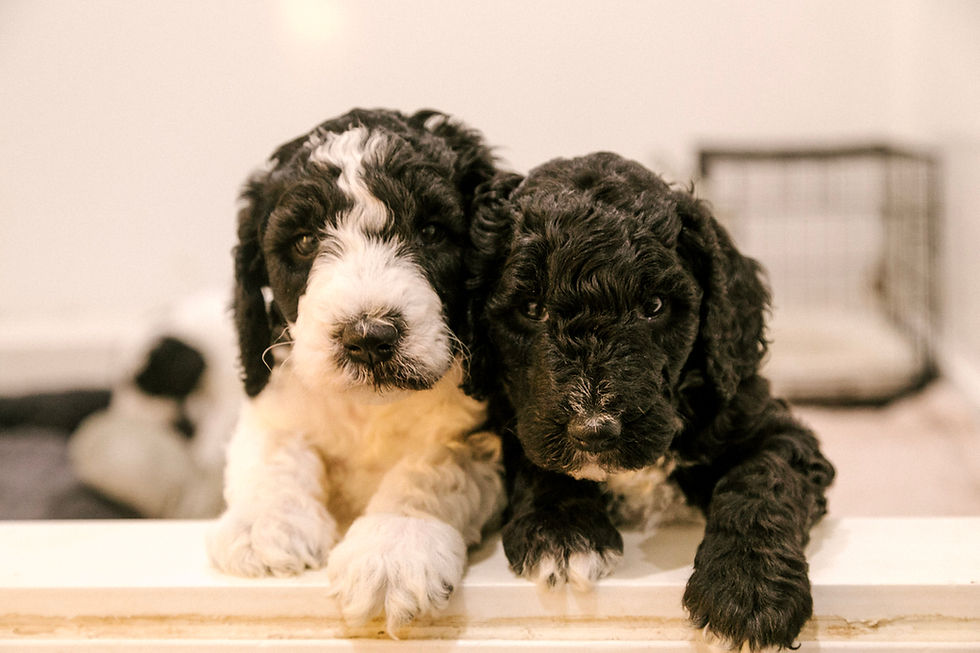
What Makes a Designer Doodle Well-Bred?

Updated: Jan 29
The term designer doodle gets used a lot — and honestly, it can mean very different things depending on who you’re talking to. A doodle being well-bred has very little to do with the name and everything to do with how and why the dogs are bred.
At JLDD, we believe a well-bred doodle is the result of intention, planning, and a whole lot of care — not just good looks or what’s trending on social media.

Health Testing Comes First (This Is Non-Negotiable)
A well-bred designer doodle always starts with health-tested parent dogs — on both sides.
That means the breeder has taken the time to screen the Poodle parent and the other breed parent for genetic, orthopedic, and breed-specific health concerns. This often includes testing for hips, elbows, heart health, and inherited genetic conditions.
There’s an important difference between “vet checked” and “health tested.” A routine vet visit tells you how a dog looks today. Health testing helps predict what issues a dog may be prone to down the road.
Skipping health testing is one of the biggest red flags we see. Responsible breeders don’t cut corners here, because long-term health matters more than fast sales.
Thoughtful Dog Pairings — Not Random Breeding
A well-bred doodle is never the result of two dogs being paired simply because they’re available.
Responsible breeders carefully choose parent dogs based on:
Health history
Temperament
Size and structure
Energy level
Compatibility between the two dogs
Founder of JennaLee Designer Doodles, Jenna Stone, explains that, "There are a variety of factors at play here, but the first question to be asked is, 'What are you trying to produce?' In our business, certain dogs can be used to produce different hybrid breeds, so after determining that, we then look at genetic and OFA testing to see which parents will produce healthy puppies unaffected by genetic abnormalities."
"Then, we look for temperament. If we're trying to produce a really mellow dog, for example, we'd want to find two more mellow parents. We also look at color testing if a certain color or coat pattern is desired."
The goal is to create puppies with balanced temperaments and predictable traits. When pairings are thoughtful, puppies are more likely to grow into dogs that fit real homes and real lifestyles.
Temperament Matters Just as Much as Looks
It’s easy to fall in love with a fluffy face — we get it. But temperament is what you live with every single day.
Well-bred doodles are produced from adult dogs with stable, predictable temperaments. That means the parents are confident, social, and able to handle everyday life without excessive fear or reactivity.
Good breeders pay close attention to things like:
How the parents handle stress
How they interact with people
How they respond to new environments
Temperament issues are much harder to “train out” later than people realize. That’s why responsible breeders put just as much weight on personality as they do on appearance.

Early Socialization Starts Before Puppies Go Home
A designer doodle doesn’t become well-adjusted by accident. Early experiences matter — a lot. Well-bred doodle puppies are exposed to normal household sights, sounds, and routines from an early age. This can include:
Gentle handling by different people
Everyday noises like vacuums and doorbells
New textures and surfaces
Age-appropriate crate and routine exposure
These early experiences help puppies build confidence and resilience. Puppies raised with intentional socialization tend to adapt more easily when they go home, making the transition smoother for everyone involved.
This is one of those behind-the-scenes details that families don’t always see — but it makes a huge difference long-term.
Clear, Honest Communication With Families
A well-bred doodle almost always comes from a breeder who communicates openly and clearly. Responsible breeders are comfortable explaining:
Their health testing
Their breeding decisions
Their process and timelines
What families should realistically expect
They don’t dodge questions or rush families into decisions. In fact, many welcome thoughtful questions because it shows a family is serious about doing things the right way.
If something feels vague or rushed, that’s usually your gut telling you something important.
Matching Puppies to Families (Not First-Come, First-Served)
One of the biggest signs of a well-bred doodle program is intentional puppy matching.
Rather than letting families choose based only on color or markings, responsible breeders take time to observe each puppy’s personality. Over the first several weeks, puppies show differences in confidence, energy level, and how they interact with people.
Matching helps ensure:
Active families get higher-energy pups
Quieter homes get calmer personalities
First-time owners aren’t overwhelmed
It’s not about control — it’s about setting everyone up for success. When puppies are matched thoughtfully, families are far less likely to experience regret or overwhelm later. It’s one of those “trust the process” moments that really pays off.
Ethical Breeding Practices Matter
Well-bred designer doodles also come from ethical breeding environments.
This includes things like:
Breeding adult dogs at appropriate ages
Providing proper veterinary care
Raising puppies in clean, enriched spaces
Responsible breeders don’t operate at high volume, and they don’t treat dogs like inventory. Each litter is planned, cared for, and raised with intention.
Ethical practices protect not only the puppies, but also the adult dogs who make future generations possible.

Warning Signs That a Designer Doodle Is Not Well-Bred
Sometimes knowing what to avoid is just as helpful. A doodle may not be well-bred if you notice:
No proof of health testing
Vague or inconsistent answers
Multiple litters always available
No interest in your lifestyle or experience
If something feels off, it probably is. Reputable breeders want the right fit just as much as you do.
Well-Bred Is About Intention, Not Trend
At the end of the day, a well-bred designer doodle isn’t defined by a label, a coat color, or what’s popular right now. It’s defined by intention, care, and responsible decisions made long before a puppy is born.
When breeders prioritize health, temperament, and thoughtful matching, families end up with dogs that truly fit their lives — and that’s where the magic happens. Slow down, ask questions, and don’t be afraid to dig a little deeper. In the long run, it’s worth its weight in gold.
Authored by the JLDD Team