


Clingy Goldendoodle? Here's How to Fix It

Updated: Aug 14
If your Goldendoodle follows you from room to room, waits outside the bathroom door, or acts like your shadow, you're not alone.
The good news is that most Goldendoodles aren't clingy because something is wrong.
They're affectionate, people-focused dogs that love being with their families. In many cases, what looks like clinginess is simply a dog that has formed a strong bond with the people it trusts most.
That said, there's a difference between a loving companion and a dog that struggles to be alone.
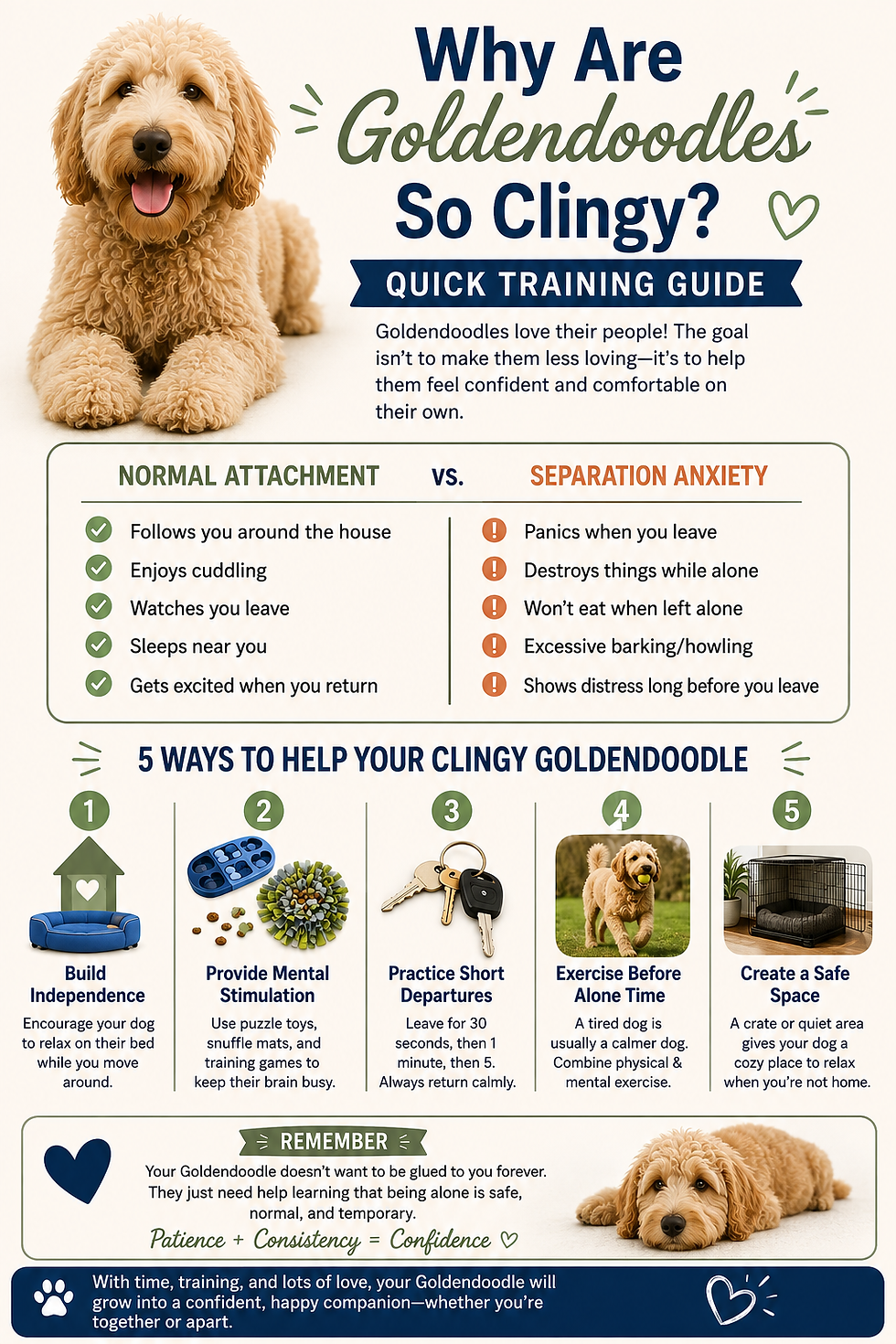
How to Tell Normal Goldendoodle Attachment vs. Separation Anxiety & Clinginess
“In my experience, anxiety is used as a blanket description for anything that the dog does that the owner doesn’t like,” says Dr. Katherine Houpt, the James Law Professor Emeritus of Behavior Medicine in the Department of Clinical Sciences.
Not every "Velcro dog" has separation anxiety. Here's how to tell the difference.
Usually Normal | May Be Separation Anxiety |
Follows you from room to room | Panics when you leave the house |
Likes to cuddle on the couch | Destroys furniture or doors while alone |
Gets excited when you come home | Barks or howls for long periods after you leave |
Sleeps near your feet | Refuses food or treats when left alone |
Watches where you go | Cannot settle down without constant reassurance |
A Goldendoodle that enjoys being close to you isn't automatically anxious. Many simply prefer to be wherever the action is. It's only when that attachment turns into panic or distress that it becomes a behavior worth addressing.
Quick Goldendoodle Clinginess Prevention Tips:
Encourage your puppy to relax on their bed while you move around the house.
Reward calm, independent behavior instead of constant attention-seeking.
Give your Goldendoodle puzzle toys, snuffle mats, or long-lasting chews when you're busy.
Practice leaving the room for short periods and gradually increase the time away.
Exercise your Goldendoodle before you leave the house.
Provide daily mental stimulation through training games and enrichment activities.
Keep departures and arrivals calm instead of making them emotional events.
Avoid responding every time your puppy nudges or follows you for attention.

How to Help a Clingy Goldendoodle
If your Goldendoodle seems attached at your hip, don't worry. Most dogs can learn to become more independent with a little patience and consistency.
The key is building confidence—not pushing them away. Think of it as teaching your dog that good things still happen, even when you're not right beside them.
Encourage Independence Around the House
One of the easiest places to start is at home.
Instead of allowing your Goldendoodle to follow you every single time you get up, encourage them to relax on their bed while you move around the house. At first, this might only last a minute or two, and that's perfectly fine.
Reward calm behavior with praise or an occasional treat. Over time, your puppy learns they don't have to keep you in sight every second of the day.
Slow and steady wins the race here. Trying to force independence too quickly usually backfires.
Give Them Something Better to Do
Sometimes a clingy Goldendoodle is simply a bored Goldendoodle.
Before leaving the room—or the house—offer an activity that keeps your puppy engaged. A stuffed food toy, puzzle feeder, snuffle mat, or long-lasting chew gives them something positive to focus on instead of watching the front door.
Mental exercise is just as important as physical exercise for this breed. In fact, a 15-minute training session can wear out some Goldendoodles just as much as a long walk.
When your puppy learns that alone time comes with something fun, they're much more likely to settle down and relax.
Practice Short Departures
If your Goldendoodle gets anxious the moment you grab your keys, start by making your departures feel normal instead of dramatic.
Leave the room for 30 seconds, then come back without making a big fuss. As your puppy becomes more comfortable, slowly increase the amount of time you're away. The goal is to show them that you always come back.
It can be tempting to rush this process, but hang your hat on patience. Building confidence takes time, and small successes add up much faster than one big leap.
"The main rule is to plan your absences to be shorter than the time it takes for your dog to become upset," writes the ASPCA.
Make Sure They're Getting Enough Exercise
A tired Goldendoodle is usually a calmer Goldendoodle.
These dogs are active, intelligent, and full of energy. If they don't have a healthy outlet for that energy, they're more likely to spend their day following you around looking for something to do.
Daily walks are important, but don't stop there. Training sessions, games of fetch, hide-and-seek, scent games, and puzzle toys all help satisfy your dog's need for both physical and mental activity.
If you know you'll be leaving the house, try exercising your Goldendoodle beforehand. Many dogs are much more likely to nap after they've burned off some energy.
Keep Goodbyes and Greetings Low-Key
One mistake we see owners make is turning every departure into an emotional event.
If you spend five minutes hugging your puppy and saying goodbye, you're accidentally teaching them that leaving is a really big deal.
Instead, keep your departures calm and matter-of-fact. Give your puppy something enjoyable to work on, head out the door, and save the excitement for later.
The same goes for coming home. Wait until your Goldendoodle settles down before giving them lots of attention. This helps teach them that people coming and going is simply a normal part of life.
Common Mistakes That Can Make Goldendoodle Clinginess Worse
Even with the best intentions, it's easy to reinforce clingy behavior without realizing it.
Instead of This... | Try This Instead |
Giving attention every time your puppy nudges you | Reward calm, independent behavior |
Letting your puppy follow you everywhere | Encourage short periods of relaxing on their own |
Making emotional goodbyes | Leave quietly and confidently |
Punishing anxious behavior | Build confidence through positive training |
Skipping exercise or enrichment | Provide daily physical and mental stimulation |
Remember, your puppy isn't trying to manipulate you. They're simply repeating behaviors that have worked before. By rewarding confidence instead of constant attention-seeking, you can gradually help them become more independent.
Can Goldendoodle Clinginess Be Prevented?
While every dog has a unique personality, early experiences can make a big difference.
During the first several weeks of life, puppies are constantly learning about the world around them. Positive experiences, gentle challenges, and new environments all help build confidence.
That's one reason we're such big believers in Puppy Culture. Puppies are introduced to new sights, sounds, textures, problem-solving activities, and age-appropriate independence exercises.
These experiences help them learn that new situations aren't scary—they're just part of everyday life.
Temperament matching also plays an important role. Every puppy has its own personality, and no two are exactly alike. Matching each puppy with the right family helps set everyone up for success from the very beginning.
Of course, once your puppy comes home, that learning continues. Families who consistently encourage confidence, independence, and positive routines often find their puppies adjust much more easily as they grow.
More Detail About Why Goldendoodles Can Be Clingy
They're Bred to Be Companion Dogs
Goldendoodles weren't developed to be independent working dogs that spend all day on their own. They were bred by combining two breeds that genuinely enjoy being around people.
Golden Retrievers have spent generations working alongside hunters and families.
Poodles are incredibly intelligent dogs that thrive on interaction and teamwork. Put those traits together, and you get a dog that's happiest when it's part of everyday life.
That people-first personality is one of the reasons Goldendoodles make such wonderful family dogs. It also explains why many of them naturally want to be wherever you are.
They're Incredibly Smart
Goldendoodles don't just notice routines—they memorize them.
They quickly learn what grabbing your keys means, which shoes you wear when leaving the house, or what time dinner usually happens. Before long, they start anticipating your next move.
Because they're so observant, they also become very tuned in to their owners. If you move to another room, chances are they'll decide it's worth checking out too.
Curiosity and intelligence often look like clinginess, even when your dog is simply interested in what you're doing.
They Haven't Learned Independence Yet
This is especially common with puppies.
When a new puppy comes home, everyone wants to cuddle, play, and spend every waking minute together. We don't blame you—it can be hard to resist that fluffy little face.
But if a puppy never practices being alone for short periods, they may start believing they always need someone nearby to feel safe. Before you know it, you've got a little shadow following you everywhere.
The good news? Independence can be learned, just like walking on a leash or sitting politely.
Every Goldendoodle Has a Different Personality
Not every Goldendoodle is the same.
Some puppies are naturally outgoing and confident. Others are a little more sensitive and enjoy staying close to the people they trust. Neither personality is wrong—they're simply different.
That's one reason we spend so much time getting to know each puppy before matching them with a family. A confident, adventurous puppy may fit perfectly with an active household that's constantly on the go.
A puppy that enjoys staying close to its people may be a better fit for someone who works from home or wants a constant companion.
Early puppy raising also plays an important role. Programs like Puppy Culture expose puppies to new experiences while encouraging confidence and problem-solving.
Those small experiences can help puppies grow into adults that feel comfortable exploring the world instead of relying on their owners for reassurance every step of the way.

Recent posts:
Frequently Asked Questions
Why does my Goldendoodle follow me everywhere?
Goldendoodles are naturally social dogs that enjoy being close to their families. Following you from room to room is usually a sign of affection rather than a behavior problem. If your dog can still relax when you're away, it's generally considered normal.
Are Goldendoodles prone to separation anxiety?
Some Goldendoodles can develop separation anxiety because they're such people-oriented dogs, but it's not something every Goldendoodle experiences.
Early independence training, regular exercise, and confidence-building activities can help reduce the risk.
At what age do Goldendoodles become more independent?
Many puppies become more confident as they mature, especially during their first one to two years.
Consistent training and positive experiences during puppyhood often have the biggest impact on long-term independence.
Should I ignore my clingy Goldendoodle?
You shouldn't ignore your dog completely, but you also don't need to respond every time they ask for attention. Instead, reward calm, independent behavior so your
Goldendoodle learns that relaxing on their own is a good thing.
Can exercise help reduce clingy behavior?
Yes. Physical exercise combined with mental enrichment often helps reduce boredom and excess energy, both of which can contribute to attention-seeking behaviors.
A well-exercised Goldendoodle is generally more relaxed throughout the day.
Will crate training help with clinginess?
When introduced properly, crate training can give your Goldendoodle a safe, comfortable place to relax.
It should always be a positive experience and never used as punishment. Many dogs learn to settle more easily when they have a quiet space that's all their own.
You Got This
Goldendoodles are known for forming incredibly strong bonds with their families. That's one of the reasons so many people fall in love with the breed.
If your Goldendoodle follows you everywhere, chances are they're simply showing how much they enjoy being with you. In most cases, that's completely normal.
If their attachment starts turning into anxiety, don't panic. With consistent training, plenty of mental and physical exercise, and opportunities to build confidence, most Goldendoodles learn that being alone for short periods is nothing to worry about.
The goal isn't to make your Goldendoodle less loving. It's to help them become a happy, confident companion who feels just as comfortable relaxing on their own as they do curled up next to you.
Authors: The JLDD Team provides expert guidance on Doodles, puppy care, training, and responsible breeding based on years of real-world experience.


